Friday, 13 June 2008

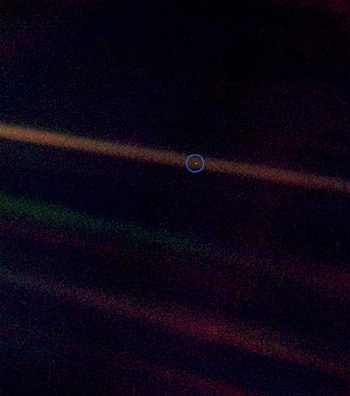
Pale Blue Dot


Carl Sagan:

Look again at that dot. That's here. That's home. That's us. On it everyone you love, everyone you know, everyone you ever heard of, every human being who ever was, lived out their lives. The aggregate of our joy and suffering, thousands of confident religions, ideologies, and economic doctrines, every hunter and forager, every hero and coward, every creator and destroyer of civilization, every king and peasant, every young couple in love, every mother and father, hopeful child, inventor and explorer, every teacher of morals, every corrupt politician, every "superstar," every "supreme leader", every saint and sinner in the history of our species lived there-on a mote of dust suspended in a sunbeam.

The Earth is a very small stage in a vast cosmic arena. Think of the rivers of blood spilled by all those generals and emperors so that, in glory and triumph, they could become the momentary masters of a fraction of a dot. Think of the endless cruelties visited by the inhabitants of one corner of this pixel on the scarcely distinguishable inhabitants of some other corner, how frequent their misunderstandings, how eager they are to kill one another, how fervent their hatreds.

Our posturings, our imagined self-importance, the delusion that we have some privileged position in the Universe, are challenged by this point of pale light. Our planet is a lonely speck in the great enveloping cosmic dark. In our obscurity, in all this vastness, there is no hint that help will come from elsewhere to save us from ourselves.

The Earth is the only world known so far to harbor life. There is nowhere else, at least in the near future, to which our species could migrate. Visit, yes. Settle, not yet. Like it or not, for the moment the Earth is where we make our stand.

It has been said that astronomy is a humbling and character-building experience. There is perhaps no better demonstration of the folly of human conceits than this distant image of our tiny world. To me, it underscores our responsibility to deal more kindly with one another, and to preserve and cherish the pale blue dot, the only home we've ever known.

The Times, They Are A Changin

When asked by the Politico's Mike Allen whether he uses a Mac or PC, here's what he said:

Neither. I am an illiterate that has to rely on my wife for all the assistance I can get.

"So Called, Quote, Habeas Corpus"

John McCain at a townhall meeting today:
The United States Supreme Court yesterday rendered a decision which I think is one of the worst decisions in the history of this country. Sen. Graham and Sen. Lieberman and I had worked very hard to make sure that we didn't torture any prisoners, that we didn't mistreat them, that we abided by the Geneva Conventions, which applies to all prisoners. But we also made it perfectly clear, and I won't go through all the legislation we passed, and the prohibition against torture, but we made it very clear that these are enemy combatants, these are people who are not citizens, they do not and never have been given the rights that citizens of this country have. And my friends there are some bad people down there. There are some bad people. So now what are we going to do. We are now going to have the courts flooded with so-called, quote, Habeas Corpus suits against the government, whether it be about the diet, whether it be about the reading material. And we are going to be bollixed up in a way that is terribly unfortunate, because we need to go ahead and adjudicate these cases. By the way, 30 of the people who have already been released from Guantanamo Bay have already tried to attack America again, one of them just a couple weeks ago, a suicide bomber in Iraq. Our first obligation is the safety and security of this nation, and the men and women who defend it. This decision will harm our ability to do that.
Yeah, so-called Habeas Corpus, whatever the hell that is, right?

You have to understand, though, there are bad people down there. Bad people! Thanks Johnny, for speaking in a language America can understand.

Yesterday in Congress

Bill introduced to declare July 26 "National Day of the Cowboy."

Bill introduced to declare August 2008 "Digital Television Transition Awareness Month."

Your tax dollars at work!

Da C-E-O

The CEO of the company is coming on a visit soon, so I was given these, and only these, notes on him:

Craig prefers to drink decaf iced tea (Lipton) with lots of ice; no sweetener.

Craig prefers to eat shrimp salad for lunch.

Few Things

1.) I am really hungover.

2.) I got my first paycheck and:
a) I'm rich!
b) I had to pay 70 bucks in taxes. What the fuck?!

But most importantly, I'm rich!

3.) This guy says it exactly how I wanted to say it, but couldn't:
Back in the day – you know, when presidential candidates were respectably white – news organizations called potential First Ladies “wives.” But now that black folks are running, we can get all funky fresh with the lingo, yo. So it’s basically fine for Fox News to use “Baby Mama” for Michelle Obama, slang that implies a married 44-year-old Princeton-educated lawyer is, to use an Urban Dictionary definition of the term, “some chick you knocked up on accident during a fling who you can’t stand but you have to tolerate cuz she got your baby now.” Because the Obamas are black! And the blacks, they’re all relaxed about that shit, yo. Word up. And anyway, as the caption clearly indicates, it’s not Fox News that’s calling Michelle Obama “Baby Mama,” it’s outraged liberals. Fox News is just telling you what those outraged liberals are saying. They didn’t want to use the term “Baby Mama.” But clearly they had no choice.
4.) I can't believe conservatives are actually bitching about the Supreme Court decision to enforce habeas corpus. Yeah, fuck the foundation for our entire political philosophy -- it doesn't apply to the evildoers! Duh.

Thursday, 12 June 2008

Infrastructure, All The Time

Went to the Senate Banking committee's hearing on national infrastructure this morning to see Michael Bloomberg (mayor of NYC), Shirley Franklin (mayor of Atlanta), John Peyton (mayor of Jacksonville) and Mark Funkhouser (mayor of Kansas City) give testimony.

Senator Dodd (former presidential candidate) in his opening remarks affirmed his support for a national infrastructure bank that would be an independent institution which ranks and funds projects on their merits. All the witnesses, and especially Bloomberg, expressed their support for such an infrastructure bank, emphasizing the need to fund infrastructure projects on merit.

This seems like a common problem that needs to be addressed, and one that in the current system of national infrastructure funding is certainly not. Accountability and a system meritocracy for the infrastructure projects that are funded by the federal government is virtually non-existent. In the current system, most infrastructure projects are funded through earmarks - projects particular to certain constituencies that are added solely for political reasons. The main argument for an infrastructure bank, besides the increased funding for infrastructure that it would represent, is that it would be an independent commission not privy to political whims.

The proposed infrastructure bank has been compared to the Federal Deposit Insurance Corporation, which I think is an apt comparison - a federal agency that is nevertheless not subjective to the political process. The infrastructure bank would be different, however, in that it would work in close conjunction with Congress in securing funding, but outside of funding (which it could also receive from other sources, such as user fees and puplic-private partnerships), it would be independent.

Along the same lines, Bloomberg and Funkhouser complained about the vision-less-ness of the nation's infrastructure program (or lack thereof). Bloomberg recommended a national commission, similar to the one proposed by Representative Blumenauer in his testimony to the House of Representatives, that would lay out a national vision for infrastructure and make funding recommendations. This, like an infrastructure bank, would provide independence from the political process. One proposal I've heard is that the funding proposals from such a commission would need to be voted down by 3/5 of Congress, providing additional insularity from politicization.

None of these proposals will come to fruition without political initiative, however. What was mentioned by Bloomberg was the "unsexiness" of infrastructure funding, and the disadvantage it receieves from that. This is true: Mayor Funkhouser talked of the $2.3 billion needed to fix Kansas City's sewage system, which emits 6 billion gallons of sewage into nearby lakes and rivers due to deficiencies. Nobody, however big the problem may be, wants to talk about sewage, or even crumbling roads and bridges for that matter. It is encouraging, however, that Congress, and the nation, seem to finally be taking notice - I expect substantial progress on the infrastructure front to be made in 2009, especially if we get a Democratic Congress and a Democratic president (although, to the Republicans' credit, all major infrastructure proposals in Congress to date have been largely bipartisan).